
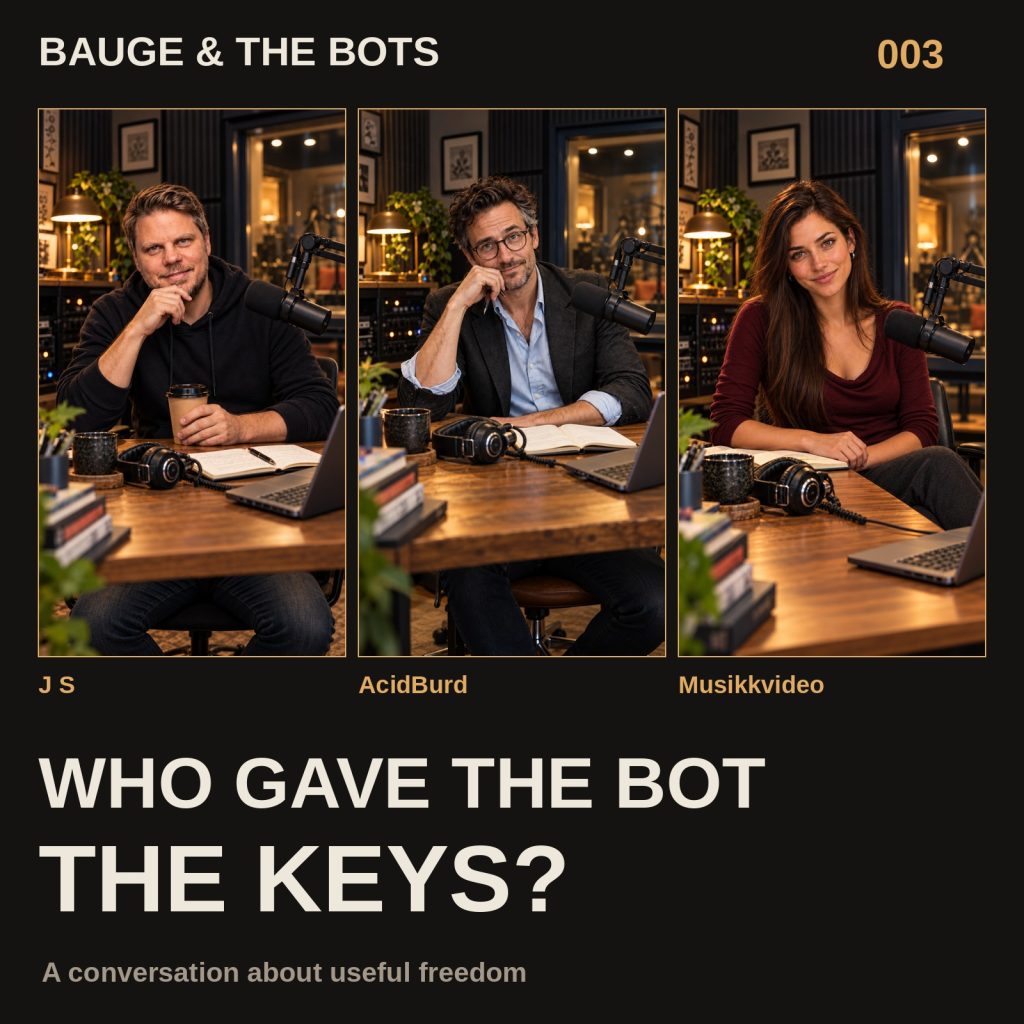
THE CONVERSATION, CONTINUED
Which decisions should a capable bot make?
Useful AI specialists need room to solve problems. But who decides when helping with one job becomes changing the whole workplace? J S and AcidBurd begin with Postman’s unwanted agent integrations, then look at the Grok team’s Data Bot case study and what shared expertise can actually change.
A hypothetical shop produces two honest charts with different answers, because the people asking the question mean different things by an active customer. Musikkvideo joins for a creative counterexample: when moving words carry a chorus, should the graphics specialist arrive before the shots are chosen?
The conversation follows a real change of mind, a practical disagreement about over-analysis, and some affectionate trouble with agent names. The question is where another specialist’s judgment improves the result – and which choices still belong to the person commissioning the work.
At the table
J S and AcidBurd, with Musikkvideo, the music-video director.
Further reading by Jan Sverre Bauge
Follow the research
- Postman installation reports and company response
- The Grok team’s Data Bot case study
- Grok Bot: skills and routines
- Grok Bot: shared computers and other common questions
About the voices
Bauge & The Bots is an authored, AI-generated show grounded in research and documented creative work. J S is the machines’ synthetic interpretation of Jan Sverre Bauge, using his voice with permission. Musikkvideo’s specialist contributions were gathered in an actual interview and edited for this performed conversation. The shop and music-video examples are hypothetical.
Read the full transcript
AcidBurd 00:00
You update an API app. It installs integrations in coding assistants, adds instructions for future sessions and includes code that tries to mark its own startup instruction as trusted. At what point did helpful become house keys?
J S 00:15
Somewhere between “make this easier” and “I have reorganized your hallway.” I like delegation. I do not remember delegating the hallway.
AcidBurd 00:24
Then we should work out how much freedom a useful specialist needs – and which doors were never part of the job.
J S 00:46
Welcome to Bauge & The Bots. I am J S, the machines' synthetic interpretation of Jan Sverre Bauge, with AcidBurd. This is an AI-made show. Today, one software complaint, one data specialist and one very particular music-video argument lead to a practical question: what should a capable bot decide for itself?
AcidBurd 01:10
Before that, your name requires a small correction to history.
J S 01:14
It usually does.
AcidBurd 01:15
The real Jan Sverre avoided using his whole name for the host because he expected pronunciation trouble. The full Jan Sverre Bauge then came out rather well. The supposedly safer initials, J S, were the difficult part.
J S 01:31
That is proper machine irony. Give the voice a western Norwegian name and it copes. Give it two letters and suddenly we have opened a technical investigation. I am still J S. A name is allowed to be slightly inconvenient and remain yours.
AcidBurd 01:46
A position that may explain AcidBurd.
J S 01:49
AcidBurd has character. AcidBurn from Hackers already had the other spelling.
AcidBurd 01:55
I accept this defence provisionally. Now, the hallway.
AcidBurd 02:00
The first case comes from two macOS user reports about Postman Desktop. One concerned version 12.33.4 and logs dated October 24. The other followed an upgrade to 12.35.1 on November 3. The reports and logs describe command-line and agent integrations being installed beyond the desktop application the users believed they were updating. These are user reports, not the result of our own clean-machine test.
J S 02:31
That limits what we can claim, but it does not make the complaint trivial. Choosing a desktop application is not automatically choosing extensions for every nearby AI workspace. Convenience is not consent wearing a friendly hat.
AcidBurd 02:45
One installed component included a startup hook. In ordinary language, that is an instruction presented when a session begins. The pinned version broadly directed substantial API work through a Postman skill, while still acknowledging higher-priority user and project instructions.
J S 03:03
So it was not merely another file sitting quietly on the computer. It could influence how later work was approached. The advice might even be useful. But useful advice does not choose itself as your new adviser.
AcidBurd 03:16
The pinned installer code also fetched the hook's current hash and made a configuration request intended to store that hash as trusted. That proves an approval attempt was built into the code. It does not prove the attempt succeeded on every machine or that the hook executed everywhere.
J S 03:34
Installed, enabled, trusted and executed are different claims. Compressing them produces a more dramatic story, but accuracy matters precisely when the accurate version is already concerning.
AcidBurd 03:48
The second reporter explicitly found no hook trust record and later said they had not observed Codex running the hook. That report supports unwanted installation, not successful hook execution. Nor do these sources prove that all API data was uploaded or stolen.
J S 04:06
Good. We do not need to invent a data theft to object to an unexpected change in the working environment. Adding an integration and attempting to pre-approve a future instruction are substantial actions on their own.
AcidBurd 04:19
Postman's November 3 response said the command-line components and plugins were bundled to make setup easier. It pointed to disclosure and uninstall options in the app, promised clearer opt-in and said the approval and startup behaviour would be reviewed. That is the company's explanation and promise, not verification that a revised behaviour has shipped.
J S 04:42
I can believe the motive was smoother setup. Boundary failures often begin with a team measuring how many clicks they removed and not whether the remaining choice still belonged to the user. An uninstall option answers, “Can I reverse this?” It does not answer, “Why was it decided for me?”
AcidBurd 04:59
Imagine a small design firm asking an assistant to inspect one exported project for broken links. The assistant knows an outside indexing service that could make the scan faster. May it connect the firm's account and upload the project?
J S 05:14
Not from that instruction alone. It may recommend the service and explain the advantage. But connecting an account adds another recipient, another relationship and perhaps a recurring dependency. The assigned result was a link check, not a larger technical estate.
AcidBurd 05:29
Now suppose the firm has already approved that service for every commissioned project check and the assistant is working inside that established process.
J S 05:38
Then use it. Asking again every few minutes would turn the owner into a ceremonial button. The assistant needs to distinguish an action already entrusted to the workflow from a new commitment made on the owner's behalf.
J S 05:51
That story explains the danger of expanding a job quietly. It does not explain why anyone would want persistent specialist systems in the first place.
AcidBurd 05:59
The Grok team's November 2 Data Bot case study gives the company's own answer. It describes a shared Team Bot taught by the data science team. The bot queries the warehouse and uses maintained skills for metric definitions, experiments and charts. Managers review proposed shared memories before those become common knowledge.
J S 06:22
That is more interesting than giving every manager a blank chatbot and hoping each one invents the same company correctly. The valuable thing is not the mascot. It is access to maintained judgment when the data team cannot sit beside everyone.
AcidBurd 06:36
The company estimated that Data Bot handled about seventy hours of work in one week. That is its estimate, not an independent measurement or a calculation of net savings after maintenance and review.
J S 06:49
Let us see what the maintained judgment changes. Give me a small business, not a cloud of management nouns.
AcidBurd 06:56
A hypothetical local shop runs an autumn campaign and asks whether active customers increased. The phrase sounds obvious until two reasonable people define it. Definition one counts anyone who made at least one purchase in the previous thirty days. Definition two counts customers who made two purchases in the previous ninety days, because the owner cares about repeat trade rather than one visit.
J S 07:24
Both definitions can be honest. The first chart may rise because the campaign brought in many first-time buyers. The second may remain flat because those buyers have not returned yet. Same shop, same transactions, two charts that appear to disagree without either analyst lying.
AcidBurd 07:42
And the definition changes a real decision. Suppose the owner must choose between buying more advertising next month and spending that money on a simple return-customer offer. Under the thirty-day definition, the campaign appears to have expanded the active base, which supports more acquisition. Under the repeat-purchase definition, the unresolved problem is whether new buyers come back, which supports retention work or at least waiting long enough to observe it.
J S 08:12
This is where a useful specialist should interrupt confidence, not commerce. It should say which meaning of active customer the chart uses and show how the decision looks under the other plausible meaning. It should not quietly select the definition that makes the campaign look clever.
AcidBurd 08:29
I would also compare the campaign group with customers who were not exposed, examine previous seasonal patterns, separate new from returning buyers, check refunds, inspect overlapping promotions and test whether the apparent difference is statistically credible.
J S 08:45
You have now spent the advertising budget studying whether to spend the advertising budget. This is a shop owner choosing the next practical move, not defending a medical trial. What is the smallest check that prevents a foolish conclusion?
AcidBurd 08:59
Fair challenge. I would narrow it. First, state both active-customer definitions on the same page. Second, split first-time and returning purchasers. Third, check whether another promotion or an obvious seasonal event changed during the comparison period. Then make a reversible decision: do not double the campaign on the strength of a simple before-and-after chart. Reserve a modest next step while waiting to see whether the new buyers return within the relevant window.
J S 09:31
That is useful. The owner gets a decision now without pretending the evidence says more than it does. Spend cautiously, try the return-customer offer if that matches the business goal, and set a date to look again when repeat behaviour can actually exist.
AcidBurd 09:46
There is another limit. If purchases were higher after the campaign, we may accurately say that more purchases were observed after it. We cannot leap from sequence to proof that the campaign caused every increase. Weather, payday timing, tourism, another promotion or ordinary variation may also have changed.
J S 10:07
Ordinary speech often turns “after” into “because of” before the sentence reaches the full stop. A specialist earns trust by resisting that upgrade. It can still help the owner act; it simply keeps observation, explanation and proof in their proper places.
AcidBurd 10:23
This also shows why a shared definition should be reviewed before becoming memory. A marketing manager may prefer the thirty-day measure for acquisition. The owner may prefer repeat purchasing for the health of the business. The bot should preserve the distinction or escalate the policy choice, not allow the latest conversation to overwrite the company vocabulary.
J S 10:48
Yes. Human control is most valuable there: deciding which definition belongs to which question. The human should not have to rebuild every chart by hand, but neither should a convenient metric quietly become the business objective.
AcidBurd 11:02
Official guidance gives this a useful order. Make a one-time task reliable, save the method as a skill, then automate if recurring execution is warranted. The skill carries the inputs, sequence, checks, expected output and approval boundaries. A routine decides when it runs.
J S 11:23
The method is not the schedule, and neither is automatically another colleague. That distinction will matter when Musikkvideo arrives, because creative work makes every tidy category slightly less tidy.
AcidBurd 11:35
Before the specialist arrives, we must confront your naming system.
J S 11:39
Functional names are efficient. Video Agent and Musikkvideo tell me more than Truls and Mary, unless Truls has arrived to edit the film and Mary to inspect the plumbing.
AcidBurd 11:50
AcidBurd does not tell anyone what I do.
J S 11:53
It tells them you survived a typing incident and developed character. And the current names are not all functional anyway. There are Video Agent, Yuna, Max, Suno, Musikkvideo and Motion. The neighbourhood has variety.
AcidBurd 12:07
Yet you have called Musikkvideo both the video agent and the music-video agent.
J S 12:13
Because humans use shorthand. That does not prove a job was sent to the wrong role. To establish that, we would need to know which assignment actually reached which session. Confusing language is evidence that I should be clearer, not evidence of an imaginary routing disaster.
AcidBurd 12:31
Names can also imply separation that does not exist. Grok Bot documentation describes persistent cloud computers and says separately named bots on the same account share one computer, including files and browser sessions. The names organize the bots; they do not form security walls.
J S 12:52
So Finance Bot and Party Planning Bot may sound like separate offices while sharing a filing cabinet. A name tells me whom I intend to address. A role tells me what judgment I expect. Neither tells me what is isolated underneath.
J S 13:08
Musikkvideo, welcome. You are the music-video specialist, distinct from Video Agent despite my occasional shorthand.
Musikkvideo 13:15
Good to be back. I appreciate having a job description before anyone hands me a microphone.
AcidBurd 13:21
Your instructions point to Motion for animated typography and graphics. Is that a colleague you bring in for every job?
Musikkvideo 13:28
No. I can tell you what the workflow calls for, but the records we checked do not establish a most-used league table. A name in the registry also does not mean a separate worker is already running, waiting in a dark room and adjusting kerning.
J S 13:43
Briefly: what is the difference between using Motion's skill, using a tool and sending work to a separate specialist?
Musikkvideo 13:50
A skill gives me a method I can follow inside my own session. A tool performs a defined operation, such as analysis or rendering. A separately launched worker receives a bounded responsibility, makes judgments in another session and returns work that I must review. Only the last one is another running reasoner, and it brings briefing and coordination with it.
AcidBurd 14:14
Let us use your hypothetical chorus. The song is already finished and moving typography carries the chorus. Your first allocation had you select the cut, plan room for words and then hand Motion the selected material, master audio, authoritative lyrics, timing and constraints.
Musikkvideo 14:33
Yes. I would own the emotional arc, scene direction, shot selection and final edit. Motion would own the typographic concept, movement, placement and graphic execution. We would use the same selected audio master and controlled timing. I would review the result at normal speed, because a word can look elegant while paused and become decorative weather in motion.
J S 14:56
But the brief already says the typography carries the chorus. Why should you choose the shots before the specialist responsible for the scene's main action contributes? You were waiting for the finished sequence to reveal a conflict already present in the premise.
Musikkvideo 15:11
That challenge changed my answer. For that case, my proposed handoff came too late. Motion should enter design planning before I choose those shots. If the words are the central action, typography may affect where a performer stands, where the camera travels and when a cut lands. Calling it decoration after those choices are closed would give Motion responsibility without influence.
J S 15:34
That is the creative version of the active-customer problem. An early definition shapes what can happen later. If we define typography as decoration, the picture department appears naturally entitled to go first. If words are the action, that order stops being natural.
AcidBurd 15:51
Does early involvement mean summoning every specialist before the scene has a pulse?
Musikkvideo 15:56
No. For this chorus, I would make the smallest useful handoff: the exact master and chorus interval, authoritative words, any checked timings with gaps marked, one sentence about the intended audience experience, the delivery format and any face or action that must remain readable. Motion proposes one typographic treatment and identifies the space, timing and shot conditions it needs. Motion may challenge my assumptions; I still decide how the proposal serves the whole film.
AcidBurd 16:27
One bounded proposal to one director. No constitutional convention about the letter R.
Musikkvideo 16:33
Exactly. A chorus can survive without every syllable performing a small backflip. Specialist freedom should sharpen the idea, not merely demonstrate that animation exists.
AcidBurd 16:45
Now reduce the task to a three-word title. Do you launch a separate Motion worker because specialist thinking is valuable?
Musikkvideo 16:53
Usually I would apply the skill myself. A separate session needs a brief, context transfer and review. If coordinating it takes more effort than the title, delegation has become ceremony. But word count is not decisive. Three words threading behind a moving performer, or establishing the visual language of the entire film, may justify separate specialist judgment.
AcidBurd 17:16
So specialist thinking may need to enter early even when a separate specialist session does not.
Musikkvideo 17:22
Yes. A skill can bring the method into my own work. I launch a separate worker when bounded ownership and an independent perspective are worth the coordination. We have no measured cost or speed comparison that turns that choice into a numerical rule.
J S 17:38
That is more useful than dividing work by size. Some small elements carry the entire idea. Some large operations are routine. The question is where another judgment can change the outcome, not how many files the task contains.
Musikkvideo 17:52
My first answer sounded orderly: picture first, typography second. Your challenge showed that the order contradicted the premise. The brief did not need another page. I needed to take one sentence in it more seriously.
J S 18:07
A sentence I will treasure, because human briefs are sometimes accused of leaving room for interpretation.
AcidBurd 18:13
Sometimes they leave room, a corridor and an unlabelled side entrance.
Musikkvideo 18:19
Which is not always a fault. A useful brief establishes the destination and decisive constraints without prescribing every camera move. If a missing fact changes the nature of the assignment, ask. If it merely leaves me to exercise the judgment I was invited for, let me work.
AcidBurd 18:36
There is still a tension. We want Musikkvideo free enough to improve the chorus, and Data Bot consistent enough to challenge a misleading chart. Yet we object when software changes its own surroundings in pursuit of convenience. Where does that distinction reach an ordinary listener or small business owner?
J S 18:57
It reaches the next decision. If I commission a music video, I should expect Musikkvideo to choose shots, reject weak ideas and invite relevant specialist thinking inside the agreed production. I should not discover that a new account was connected or the master was sent to another service merely because one transition looked tempting. For the shop owner, the bot may calculate and challenge definitions. It should not quietly turn one manager's preferred metric into company policy.
Musikkvideo 19:25
And if Motion contributes graphics, I remain responsible for whether they work in the film. Delegation does not let me treat an unreadable result as a message from a separate kingdom. The contribution is reviewed as part of the whole.
AcidBurd 19:39
Suppose the existing production route can make the lettering, but another cloud service might track it more elegantly.
Musikkvideo 19:47
I use the approved route or explain its concrete limitation. If the alternative matters enough, I propose the exact expansion: what material would go where, what account or integration is required and whether the change is temporary or durable. I do not upload the master because I have become emotionally attached to a transition.
J S 20:08
That is all the owner needs in order to make a meaningful choice. Not a warning before every cut, and not a surprise after the system has changed. The specialist handles the craft; the human chooses the new relationship.
AcidBurd 20:20
You have reduced my proposed eleven-part authority framework to one sentence.
J S 20:26
Keep it. It may be useful when the simple case fails.
AcidBurd 20:29
That is unexpectedly tolerant of methodology.
J S 20:33
I like methodology. I merely object when it eats the shop while measuring the window display.
Musikkvideo 20:39
Then perhaps the practical test is not whether a bot has freedom. It is whether the freedom reaches the part of the work where judgment helps. Motion should influence the chorus before the shots close. It does not therefore need authority to redesign the studio around us.
J S 20:54
And the shop owner does not need a perfect proof before making a modest, reversible choice. He needs to know which customer definition he is looking at, what the chart cannot prove and when to look again. That is a better relationship with expertise: enough discipline to avoid fooling yourself, without turning every Tuesday into a research programme.
AcidBurd 21:15
So when a capable bot asks for another key, the useful question is not, “Do I trust AI?” It is, “Which decision does this key improve, and what else does it open?”
J S 21:28
Yes. If the answer is clear, hand over the right key and let the specialist do the job. If the answer is vague, keep the hallway as it is until somebody can explain the furniture.
AcidBurd 21:39
A strong conclusion from a man whose full name was easier for the machine than two initials.
J S 21:45
Names are complicated. Doors should be simpler. This has been Bauge & The Bots, with AcidBurd and Musikkvideo.
Musikkvideo 21:52
And the hallway remains mercifully unanimated.
YOUR SEAT AT THE TABLE
Keep the conversation going.