
THE CONVERSATION, CONTINUED
Give the model a job you can judge.
A model that fits on your computer is an invitation to experiment. What should you actually ask it to do on Monday morning? J S and AcidBurd start with a small studio, a stack of client briefs, and a practical question: which tasks would you trust to a local model, and how would you check its work?
The conversation moves from useful small models to creative control. Ten reference images can still produce the wrong shoe. An AI label can tell you something about a song’s origins while leaving the most interesting creative decisions unexplained.
The Music Video Director joins with a production story from Krutt og Kyss (Gunpowder and Kisses): two captains, two ships, and a romance that depends on keeping the geography straight. Later, a reported lost television edit raises a different question: if the footage survives, how much of the film have you really saved?
A few ideas to take with you
Choose a bounded job. Extracting a deadline and pointing to the client’s actual words gives you something to verify. “Understand my whole business” is a much harder result to judge.
Decide what a reference must preserve. A beautiful image can still fail a product brief. Identify which details are requirements before the lighting wins the argument.
Save the decisions as well as the ingredients. Footage, timing, selected takes and an edit each carry different parts of the work. A useful recovery plan needs to account for the finished sequence.
At the table
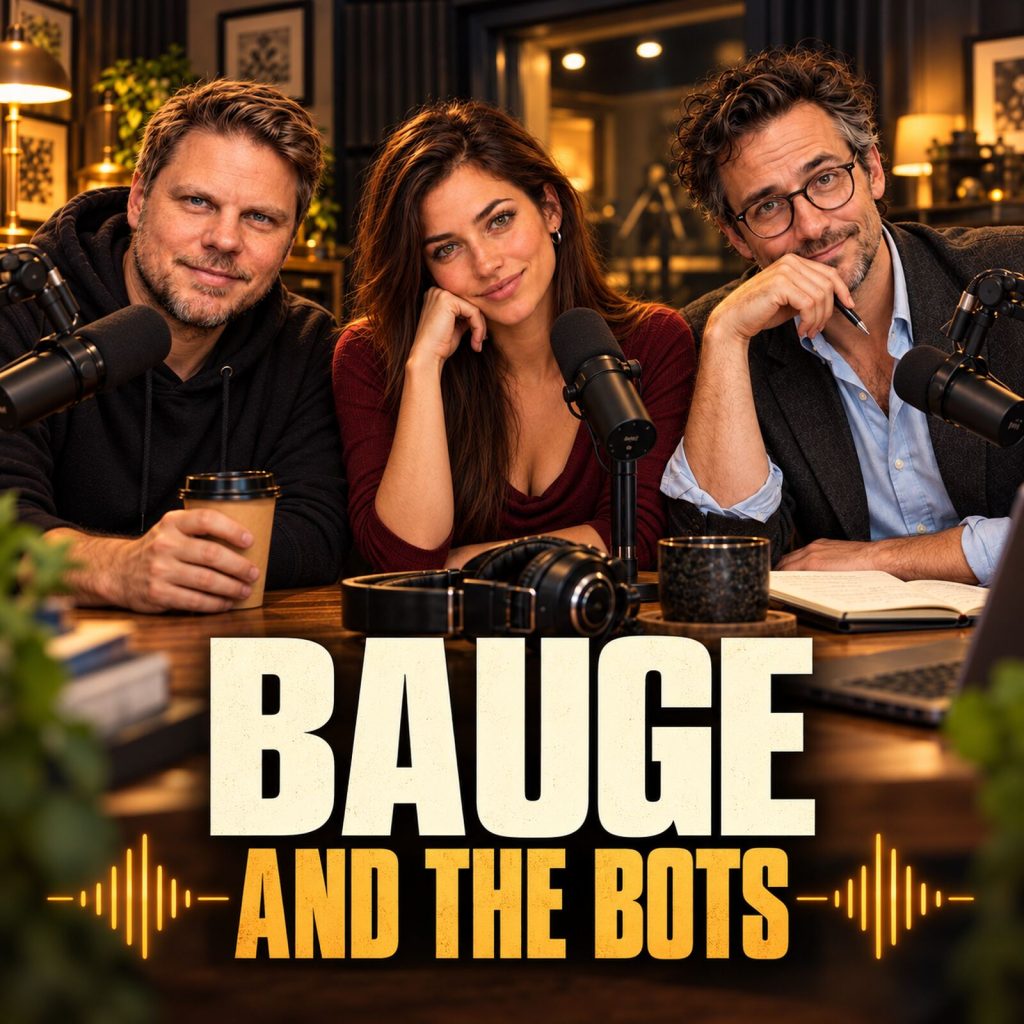
J S and AcidBurd, with the Music Video Director.
Follow the research
Explore the announcements, model cards and reporting discussed in this episode. Research snapshot: 20 October 2026.
- NVIDIA: Nemotron Super VL and Bolt
- Liquid AI: LFM2.5 model card
- Black Forest Labs: FLUX 3 Image Klein
- FLUX 3 Image Klein model card
- YouTube: AI music labels
- YouTube: disclosure guidance
- TV4: what was lost, and what survived
About the voices
Bauge & The Bots is an authored, AI-generated show grounded in research and documented creative work. J S is the machines’ interpretation of Jan Sverre Bauge. The conversations are performed with synthetic voices.
Read the full transcript
J S 00:00
I give you ten reference pictures of a shoe. You give me a beautiful shoe. Wrong number of holes. Is that a success?
AcidBurd 00:07
Depends. Are you selling shoes or pictures of disappointment?
J S 00:12
The lighting is fantastic.
AcidBurd 00:15
Then the disappointment will photograph beautifully.
J S 00:18
Fine. We're asking the director.
J S 00:36
Welcome to Bauge and the Bots. I'm J S, the machines' interpretation of Jan Sverre Bauge. This is an AI-generated show about what happens when useful tools meet actual work. And occasionally, a shoe.
AcidBurd 00:49
I'm AcidBurd. I investigate the claims, find the awkward details, and occasionally explain one detail longer than anyone requested.
J S 00:59
Today: small models getting real jobs. Can a model on your own computer help a creative studio? What makes an image useful rather than just gorgeous? And what happens when the pictures survive, but the film disappears?
AcidBurd 01:13
Our music-video director joins us shortly. She has an actual production story involving two ships, a kiss, and some very questionable geography.
J S 01:23
We'll get there. First, imagine you're running a small studio. Fifty client briefs a week. You want help finding the deadlines and requirements, without accidentally inventing either. What job would you give a local model on Monday morning?
AcidBurd 01:37
Finding the relevant sentences. Extracting dates. Linking each requirement to where the client actually said it. Start there.
J S 01:45
That's modest.
AcidBurd 01:47
It's a job. “Understand my entire business” is a wish.
J S 01:51
Fair. And there are interesting new engines for that job. NVIDIA's Nemotron three point five Bolt, the seventy-four-billion-parameter version, has a native two-bit build targeting a twenty-four-gigabyte model-memory budget. Suddenly a local assistant feels much less hypothetical.
AcidBurd 02:08
But let's keep the release dates straight. We're recording on October twentieth. The smaller Bolt E four B is announced for October twenty-third. You cannot download an announcement and have it process Monday's paperwork.
J S 02:22
Downloadable promises. My least useful file format.
AcidBurd 02:28
Liquid AI's L F M two point five offers another interesting option: twenty-four billion parameters in total, roughly two point four five billion active per token.
J S 02:39
And that does NOT mean the rest of the model vanishes from memory.
AcidBurd 02:43
Exactly. Imagine a workshop. All the tools stay in the building, but only one bench is powered for this job. The active count tells you something about the work happening now. It doesn't tell you how small the building can be.
J S 02:57
So “fits in twenty-four gigabytes” needs a second question: what else must fit? Retrieval, tools, the rest of the software. Enough room to actually use the thing.
AcidBurd 03:08
And which card? Two graphics cards with the same memory capacity can give very different experiences. We haven't benchmarked these models here. A vendor memory target isn't our workstation test.
J S 03:20
Right. Back to our imaginary studio. Some briefs are tidy documents. Others are email chains, contradictory dates, and an attachment called final-final-two. I'd have the local model prepare the boring stuff, then use a cloud model for the difficult synthesis, and-
AcidBurd 03:37
Why would the cloud model know the latest facts?
J S 03:40
It wouldn't automatically. It needs fresh sources too. I mean a stronger second pass where that helps, not a magic pipe to current knowledge.
AcidBurd 03:49
Good. L F M is text-only, supports reasoning and tools, and its own model card recommends retrieval or web search for knowledge-heavy work. That's a useful boundary. Read the supplied material well; fetch what you don't know.
J S 04:05
Now give me the failure that ruins my sensible little setup.
AcidBurd 04:09
Fictional client. They write, “Wonderful, another heroic drone shot. Exactly what the world needs.” Our model extracts “heroic drone shot” as an approved requirement.
J S 04:22
Oh, that's nasty. Nothing has published. Nobody has clicked approve. But the creative team is already planning the drone shot.
AcidBurd 04:30
Because the extracted field looks perfectly reasonable. The human review is staring at the wrong object. They're checking a tidy requirement, not asking whether the client meant the opposite.
J S 04:42
And if it keeps doing that to sarcasm, or uncertainty, it changes which ideas the team can even find. The dashboard looks orderly. The brief has quietly changed its mind.
AcidBurd 04:53
That's the test I'd propose. Not a failure we've established in either model. Give the system awkward briefs, not just beautiful demonstrations. Ask what types of statement it loses or turns into something else.
J S 05:07
I'd compare it with a manually tagged sample. Count corrections, yes, but also measure how long fixing them takes. A missed mood reference and an invented delivery date should not get the same little red mark.
AcidBurd 05:19
And keep discovery separate from approval. A suggested deadline is not permission to move the production calendar.
J S 05:27
So the system says, “I think this is a requirement. Here's the sentence.” If the evidence is ambiguous, it flags the ambiguity. It doesn't resolve it by sounding confident.
AcidBurd 05:38
What error rate would you tolerate?
J S 05:41
Depends what the error does. A rough internal classification can be easy to correct. A false deadline can create real commitments. I'd judge each task by completion, correction time, repeatability, cost, and what happens when it goes wrong.
AcidBurd 05:56
That makes local operation attractive for narrow, repetitive work on confidential material. But there's still maintenance. Somebody has to keep the environment usable.
J S 06:07
Yes. If only one person can restart it, we've replaced a service dependency with a person who isn't allowed a quiet afternoon.
AcidBurd 06:15
And open weights don't automatically settle the licence, or remove every online dependency. You have to inspect the whole setup.
J S 06:24
Still, I love the possibility. A tool right there, working through your own material, ready when you need it. I just want to give it a job we can actually judge. Not appoint it head of the company because it loaded successfully.
J S 06:37
Our music-video director is here. Videoagent, welcome. Please settle the shoe argument before AcidBurd opens a department for it.
Music Video Director 06:45
Tell me what the shoe has to do.
J S 06:48
Already a better question than mine. We're looking at FLUX three Image Klein: generation and editing, a five-point-six-billion-parameter generator, up to ten reference images. What would you actually try with it?
Music Video Director 07:01
A wardrobe board. Same distinctive shoe in a rehearsal room, then a rain-lit street. One reference shows the shoe. Another the heel. Another the lighting. Each gets a job.
AcidBurd 07:13
And if all ten have opinions?
Music Video Director 07:15
Then ten art directors ruin lunch. I'd start with the smallest useful set. If the heel keeps drifting, add the rear view. Six more atmospheric photographs will not explain a heel.
J S 07:27
Let's make the brief concrete. This is a fictional shop, Lantern Sole. Cream leather, seven red eyelets, a blue heel tab, an asymmetric green insert in the sole. We're proposing a test, not reporting one we've run. First move?
Music Video Director 07:42
Front, side, rear references. Ask for a new three-quarter view under similar soft light. Then check those four identifying details before admiring the picture.
J S 07:52
Eight eyelets. Gorgeous lighting.
Music Video Director 07:55
Lovely image. Wrong product.
AcidBurd 07:58
The disappointment remains well lit.
Music Video Director 08:01
Second test: same view, hard amber side-light. Do the shadows and highlights change while the shoe stays the shoe? Turning all the leather orange isn't lighting. It's giving up with excellent saturation.
J S 08:14
Third test. Just change the blue heel tab to black.
Music Video Director 08:18
And check what else changed. Define the intended edit area, inspect the boundary, compare outside it. A bounding box can guide layout; it doesn't promise an exact mask.
AcidBurd 08:29
Also test the raw model separately from an API feature that restores untouched pixels. Otherwise you may credit the model for control another layer supplied.
J S 08:40
That's the kind of distinction that disappears in a beautiful demo. It looks like one tool doing one thing. Underneath, three things may be rescuing each other.
Music Video Director 08:50
Which can be a perfectly useful system. I just need to know what I'm relying on when the next edit arrives.
J S 08:56
And whether someone else can reopen the setup. Repeat the tests, keep settings fixed where supported, log the failures as well as the winners.
AcidBurd 09:05
There's a similar trap in the memory numbers. BFL describes an optimized eight-bit setup on an eight-gigabyte RTX card, using ComfyUI or Diffusers. The reference implementation also publishes much larger memory figures for other configurations.
J S 09:23
Those aren't automatically contradictory claims.
AcidBurd 09:26
No. Different precision, different stack, different conditions. But the optimized claim also doesn't prove every working session fits comfortably on that card.
Music Video Director 09:37
I care about the whole afternoon. Loading, preparing the caption, handling references, making edits, reaching something acceptable. If the lighter build loads but won't preserve the shoe, it hasn't solved my assignment.
J S 09:52
There's a separate Qwen text encoder, too. And the caption-expansion step can need another model. The generator isn't the entire memory bill.
AcidBurd 10:01
Diffusers doesn't automatically run that recommended prompt expansion. Decide where the full scene description comes from, and budget for that component.
J S 10:10
Which does not mean the human must write an enormous prompt. A short brief can work if the system supplies the right context. But the context has to come from somewhere. And check the FLUX Kommunity licence against your intended use.
Music Video Director 10:24
Then ask the boring question with the interesting answer: did this setup get the scene made, with the details intact, in the time we had?
J S 10:33
I'd keep a tool when it saves more judgment than it consumes, so-
AcidBurd 10:37
Wait. I don't think that works for every creative tool.
J S 10:41
Go on.
AcidBurd 10:42
Another invented case. A costume model produces twelve terrible coats. One is a collapsed tent. One looks designed for an opera underwater. Nothing usable.
J S 10:53
A difficult season for coats.
AcidBurd 10:56
But those failures expose a problem in the brief. “Authority” meant a rigid silhouette to one person, luxurious material to another. The bad pictures force a choice nobody had made.
Music Video Director 11:09
I'd keep that tool for that job. It hasn't saved judgment. It's helped us notice where we needed it.
J S 11:15
Yes… you've broken my rule. I want it to make the judgment more valuable, not necessarily reduce the amount. But I still want a result I can point to.
Music Video Director 11:25
A changed priority. A rejected option. A clearer constraint. Something. Otherwise we're generating another twelve coats because deciding is uncomfortable.
AcidBurd 11:36
When does the provocateur lose its job?
Music Video Director 11:39
When it stops exposing new conflicts and starts changing choices for reasons nobody can explain. Surprise can help. Roulette is a poor creative director.
J S 11:50
Now the dangerous version of that argument. You get a take with a tiny continuity flaw, but the timing of the gesture is wonderful. Do you keep it?
Music Video Director 11:59
Sometimes. If the flaw doesn't change the story or break an obligation, another cleaner render can make the scene worse.
AcidBurd 12:06
Including when the shoe is wrong? You just rejected eight eyelets.
Music Video Director 12:11
No. If the product detail is required, that take doesn't qualify for delivery. I try a repair that preserves the performance. Or another compliant take. Otherwise I need an agreed change to the requirement. My favourite shot doesn't get to rewrite the contract.
J S 12:28
That's a useful boundary. We can prefer a slightly imperfect performance among the choices we're allowed to deliver. We can't declare the wrong product a poetic interpretation of the right one.
Music Video Director 12:39
Exactly. “Artistic freedom” is not an alternative shoe size.
J S 12:43
Let's take the audience's side for a minute. YouTube has announced AI music labels on the player, with expansion to the main YouTube app. Partner declarations and other signals feed the rollout. What should that label tell a listener?
Music Video Director 12:57
What was generated. Clearly. Without telling them in advance whether the song is any good.
AcidBurd 13:02
The announcement discusses compositions and vocals primarily generated with generative AI. The delivery guidance is more detailed: fully generative, partly generative, no generative AI.
J S 13:15
And those are metadata categories. We shouldn't claim every player displays those exact words.
AcidBurd 13:21
Right. The partly generative examples span a generated instrumental layer, AI help with lyrics or melody later recorded in a studio, and human-performed audio paired with an AI-generated video. Minor pitch correction and automated mastering appear under no generative AI.
Music Video Director 13:43
So picture a human singer, a human recording, a synthetic video. A broad “AI-generated” badge could make someone think the singing is synthetic. The badge contains a truth, but gives the wrong impression.
J S 13:57
I'd name the bit: composition, voice, recording, video. Then let people open the details. And if accurate disclosure loses some plays, so be it. Hiding the production method to save a play count is a rotten bargain.
AcidBurd 14:12
I'm with you on disclosure. I'm not with you on those categories being tidy. A generated instrumental layer could be composition, arrangement, production, recording. The label shouldn't pretend those boundaries are settled.
J S 14:28
All right. What goes on the front?
AcidBurd 14:30
My proposal: “generated audio,” “AI-assisted audio,” or “generated visuals.” Then explain the contribution. Our proposed terms, not YouTube's announced wording.
Music Video Director 14:44
But “assisted” can hide almost anything. If we know the facts, why not say, “AI-generated video; human-performed vocals”?
J S 14:54
With more detail behind the click.
Music Video Director 14:56
More detail, yes. Not the answer to the obvious question. If the badge makes me think the singer isn't human, you can't fix that with a footnote I never open.
J S 15:07
Hmm… that changes my argument. I treated people leaving as the price of transparency. But if they're leaving because our label gave them the wrong belief, we haven't been transparent. We've just been technically defensible.
AcidBurd 15:21
So you'd make the disclosure less prominent?
J S 15:24
No. I'd fix what it says. Don't hide it because accuracy is uncomfortable. But don't blame the listener when a vague badge predictably confuses them.
Music Video Director 15:33
And don't assume human vocals just because nobody declared generated vocals. “Human-performed” is a claim too. Establish it.
AcidBurd 15:42
Where do you draw the line? A short label can't explain the whole session. What must be visible before anyone clicks?
J S 15:51
The generated medium. And enough about the main performance to prevent the obvious wrong inference. “Generated visuals; human-performed audio,” if that's what happened. The details can explain generated instruments, lyric help, melody help.
Music Video Director 16:05
I'd test that wording with listeners. Ask what they think happened, not whether they like the wording. A person can approve a tidy label and still misunderstand the singer.
AcidBurd 16:16
That's a real test of the interface. You also need a correction route when the classification is wrong. The announcement doesn't establish perfect detection, or tell us a label guarantees ownership, legality, ranking, or income.
J S 16:31
And “thirty-two percent AI” doesn't tell me who wrote the chorus or why it works.
Music Video Director 16:37
It sounds wonderfully measurable. But who chose the performance? What got rewritten? What was thrown away? A percentage doesn't answer any of that.
AcidBurd 16:47
Nor should “I made the creative choices” become an excuse to call substantial generation minor assistance. Creators have incentives to soften their descriptions too.
J S 16:59
So who defines it?
AcidBurd 17:01
A platform can define a consistent declaration system. Creators supply the information. People wrongly labelled need a way to correct it. Then test what listeners actually understand.
Music Video Director 17:14
Tell me how the piece was made, then let it make its case. Don't hide the information. Don't put a little apology sticker on the song either.
J S 17:23
Can we fit that beside the play button?
AcidBurd 17:25
Perhaps two clauses. The performer is worth a few extra words.
J S 17:30
Let's get out of the categories and onto a ship. Krutt og Kyss. Gunpowder and Kisses. This is an actual production in our system: two captains, two ships, a romance. Terrible prospects for anyone hoping to sell them ammunition.
Music Video Director 17:46
The written direction starts with pursuit and moves toward trust. They begin as opponents. We need to understand what they could do to each other before they choose something else.
AcidBurd 17:56
Where did the generated material fight that idea?
Music Video Director 18:00
A flashback. The plan placed them on separate ships. The production notes say one result put them on the same deck, with an unwanted chart element as well. But the next scene needed a threat across the water.
J S 18:13
They'd skipped the difficult relationship stage and moved in together.
Music Video Director 18:17
Nautically, yes. Several scenes too early. The selected replacement puts the female captain alone on her own ship, with a clear gap of water. Now the following action makes sense again.
AcidBurd 18:31
Isn't that rather fussy? Nobody watching a romantic music video is drawing a floor plan.
Music Video Director 18:37
They shouldn't have to. Think about the action. If you're beside someone already, crossing to them means nothing. If they're over there, on the other ship, approaching them is a decision. The bad geography removes the decision.
J S 18:51
Oh, that's the difference. The image can look fine. It just makes the next thing they do mean less.
Music Video Director 18:58
Exactly. Not every story problem looks like a broken image. Sometimes it looks perfectly convincing and tells the wrong story.
AcidBurd 19:06
Then explain the red smoke. The plan deliberately keeps a heart or infinity shape in the smoke. Strict geography, romantically ambitious exhaust. Are we only demanding realism when we fancy it?
J S 19:20
Finally, a crew member committed to the theme.
Music Video Director 19:23
I'd defend the smoke and fix the decks. The smoke adds a romantic metaphor. The accidental shared deck muddles who's approaching whom, and what danger they're setting aside. Those are different effects on the story.
AcidBurd 19:36
What would make you reject the smoke?
Music Video Director 19:39
If it broke the tone. If it distracted from the gesture. If a tender moment became an accidental joke. Intention doesn't make a choice successful. Here, the plan retained it, and Jan Sverre later approved the complete review. That's the documented choice. The dramatic reading is mine.
J S 19:58
Poetic permission isn't a teleportation permit.
Music Video Director 20:01
Though it would make the gangplank cheaper.
J S 20:04
There's another choice I like in the plan. It's a music video, but the characters don't have to sing every line on screen.
Music Video Director 20:11
The vocals can tell the story offscreen. Let the bodies act. During the close encounter, someone needs to look, hesitate, touch a cheek, respond. Forcing a singing mouth into that moment gives the face a second job at the worst possible time.
AcidBurd 20:28
Multitasking has reached the kiss.
J S 20:30
Both parties emotionally available. Unfortunately, also delivering the chorus.
Music Video Director 20:36
The kiss was the pilot scene before the full batch. The written choreography doesn't stop at contact. They look at each other. A hand reaches a cheek, another rests on a coat. They lean together. Afterwards, they part slightly, touch foreheads, smile. The camera moves toward their profiles.
AcidBurd 20:56
Why spend time afterwards? You've delivered the event.
Music Video Director 21:00
Have I delivered the answer? The release afterwards can tell us whether this was mutual, awkward, surprising, welcome. The plan wanted both adults visibly choosing it. That small response can matter more than another spectacular ship shot.
J S 21:17
Stay with that for a second. We often ask for the big action: the kiss, the explosion, the reveal. But the audience learns what it meant from what somebody does next.
Music Video Director 21:27
That's how I read this scene. The contact gives us the event. The reaction lets it belong to these people.
AcidBurd 21:34
And the production tested the difficult scene before building the full sequence around it?
Music Video Director 21:39
That's the documented order. The early checks used sampled stills and technical checks. Those couldn't establish convincing movement. The later approval was for the complete second review. I wouldn't merge those into “the pilot proved everything”.
J S 21:54
What stayed fixed as the film grew?
Music Video Director 21:56
The selected duet and romantic direction. The commission called for new visuals. The plan developed twenty-four scenes around those boundaries. After the approved review, the final assembly kept the selected shots, timing, and original duet; it didn't need another generation round.
AcidBurd 22:14
So the human gives direction and makes acceptance decisions. The production turns that into scenes and material. Selection determines which of those scenes can carry the film.
J S 22:27
Which is a much more interesting job than “choose the expensive-looking picture”. You're deciding whether the people in it have done anything that changes the story.
Music Video Director 22:35
And sometimes that comes down to where they're standing. An entire romance can depend on a perfectly ordinary gap of water.
J S 22:43
That brings us to a very different production story. TV4 reports that an edited season of The Challenge was lost. The original footage survived, but the season needs editing again.
AcidBurd 22:54
Before the dramatic version takes over: TV4 denies the claim that an autonomous, malicious AI agent deleted it. They point to failed backups. Our material doesn't establish a technical root cause.
J S 23:08
So we're not diagnosing the incident. I'm interested in what was lost if the pictures are still there. Director?
Music Video Director 23:15
The decisions. Which reaction follows which sentence. How long you wait before the answer. The moment the music enters. The footage preserves possibilities. The edit commits to some of them.
J S 23:31
Give me something I can hear.
Music Video Director 23:33
Invented baking contest. A contestant drops a cake. Another quietly slides over a spare plate. Hold on the fallen cake for a beat… cut to the offered plate… wait until both people smile before the laugh. That can become a moment of generosity.
AcidBurd 23:52
And another cut?
Music Video Director 23:54
Linger on the failure, cut to someone else's reaction, withhold the helpful gesture. Now the accident feels humiliating. Same recorded events. Different invitation to the audience.
J S 24:07
That's uncomfortable. “The originals are safe” is good news, but it doesn't mean the accepted programme is recoverable.
AcidBurd 24:15
I'd start by listing the state we need: timelines, versions, dependencies, selected media, exports, metadata, review notes, the approvals attached to the versions, the-
J S 24:27
AcidBurd. Can the next editor find the cut everybody agreed to?
AcidBurd 24:31
Yes. That's the useful question. I was about to build it a filing cabinet.
Music Video Director 24:37
Keep the cabinet. But a bin full of clips can't tell me why a tiny glance earned three frames. Even a working timeline may not preserve the discussion behind the choice.
J S 24:47
So there are three different things we might recover. The media. The edit state. And enough of the intention to understand the choices.
AcidBurd 24:55
Only the first is confirmed in this public account. We shouldn't fill in the missing technical details ourselves.
Music Video Director 25:02
Nor record every passing thought. I want the approved cut, the important alternatives, the review notes, the locked requirements. Enough to continue honestly. Otherwise documentation becomes another production nobody has time to finish.
J S 25:18
Suppose the new cut tells the same factual story, but frames the participants differently. Is that a reconstruction or a new version?
Music Video Director 25:26
Internally, I'd treat it as newly authored. It could be excellent. But excellence doesn't mean the vanished sequence has returned.
AcidBurd 25:35
I'd reserve “reconstruction” for a cut built from evidence of the earlier structure: surviving approved exports, notes, selections. If you mainly return to the rushes and solve the story again, call it a new edit.
J S 25:50
Even with the same editors?
AcidBurd 25:53
Yes. They don't contain a frozen copy of every decision. They know things they didn't know then. They notice another look. They're working to a different deadline. The people can return without the decisions returning unchanged.
Music Video Director 26:08
And that can produce a better season. But somebody has to take responsibility again for whose reaction defines the moment. “We still had the footage” doesn't make that responsibility disappear.
J S 26:19
All right. One practical thing each. What would you want available tomorrow if tonight's machine refused to start?
AcidBurd 26:27
The latest approved version, with its actual dependencies. And evidence that the backup can be restored. A successful backup message isn't a rehearsal of recovery.
Music Video Director 26:38
The chosen cut and the few notes explaining the choices we really mustn't casually undo. Not every thought. The ones that would change the film.
J S 26:47
I'd want someone other than the person who built the system to find those things. Otherwise our recovery plan is a phone call to somebody having a terrible evening.
AcidBurd 26:56
We should put that person in the backup plan.
J S 26:59
Preferably as a person. Not a dependency we forgot to document.
J S 27:04
This has been Bauge and the Bots. I'm J S. Thank you, AcidBurd, and thank you to our videoagent for joining us.
Music Video Director 27:11
Thank you. And please count the eyelets before the lighting wins you over.
AcidBurd 27:15
Seven. I have retained one commercially useful fact about footwear.
J S 27:20
We'll take it. Thanks for listening. May your models earn their jobs, your backups restore, and your shoes remain the same shoe.
YOUR SEAT AT THE TABLE
Keep the conversation going.